Ten Years In: What We've Learned From Saying Yes
Ten years is long enough to forget how small the beginning actually was. $400. A handful of trash bags. A block behind us that nobody else wanted to look at. That's where this started, not with a plan, but with obedience. Just showing up, week after week, until the mountain started to move.
You've heard some of these stories by now. Paulino and his machete. Maria's flower box. The mother who no longer has to worry about needles in the grass. Tiana on her bike. We won't retell them here. They've already been told, and they deserve to be read in full, not summarized.
But there's one story we haven't told in full yet, and it belongs here.
Before there was an organization, before there was a plan, there was a conversation with a neighbor named Irv. He didn't hand us a strategy. He just looked at us and asked why we weren't doing anything about the massive dumpsite on the corner behind us, the one everyone had learned to walk past. That question was part of the reason any of this exists. Irv was part of why we picked up the first trash bag.
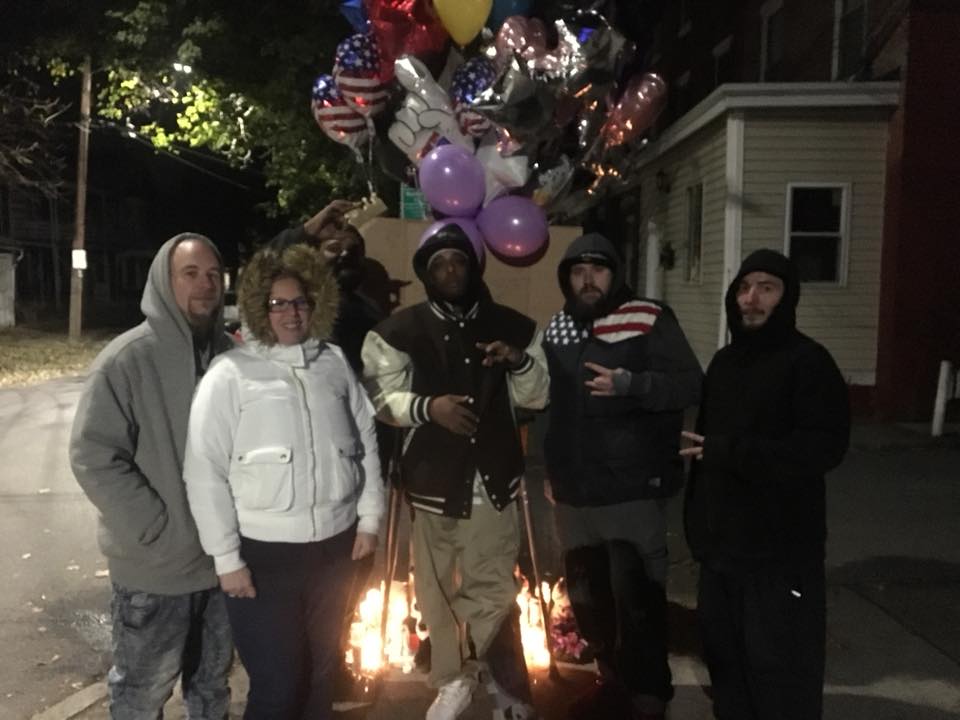
Just a year or two into this journey, we lost him. Irv died alone in an abandoned house after an overdose. No person should die like that, forgotten, in the kind of space we had already spent a year trying to reclaim. It broke something in us, and it built something too. His death is a large part of why we started boarding up abandoned houses across the neighborhood, not only to clean up a block, but because an empty, unsecured building is a place where someone can disappear without another soul knowing until it's too late. Every house we've boarded since carries a piece of his memory. Every door we've sealed shut is us saying: not again, not like that, not alone.
Irv started this by asking a question we couldn't ignore. He ended up, without ever meaning to, shaping one of the most important things we do. We think about that a lot: how the same man who lit the spark also became, in his death, part of the reason the fire kept spreading in a new direction.
Now, here's what all of it, his story and the others, adds up to.
Because here's the thing about ten years of stories like these: none of them were the plan. We didn't set out to board up houses in Irv's memory. We didn't know Paulino would show up with a machete and teach us more about perseverance than any strategy document ever could. We didn't know a flower box would end up on every home on Maria's new block. The plan was smaller than all of this. The plan was just: show up again tomorrow.
That's what ten years of "yes" actually looks like from the inside. It doesn't feel like a movement while you're in it. It feels like Tuesday. It feels like another lot, another bag, another door. And then one day you look up and it's 202 blocks. All 66 dumpsites, gone. Over 3 million pounds of trash removed. Over 16,000 volunteers who decided their Saturday belonged here. Over 10,000 neighbors whose block looks different because of it.
It's nearly $1 million raised each year, six full-time staff, a two-acre farm growing food where trash used to grow. It's a housing project about to break ground, because we learned, through the families we couldn't keep, through Anna and Alizon and the ones whose struggles stayed invisible, that clean blocks aren't enough if there's nowhere safe to live on them.
None of that happened because we were visionary. It happened because we kept saying yes to the same unglamorous thing, over and over, for ten years, and the people around us said yes with us. Irv said yes to a hard conversation. Paulino said yes to a lot nobody believed in. Neighbors said yes to trusting a rag-tag group of young people with no tools and no track record. The City said yes to partnering with us before we'd proven anything.
We think that's the real anniversary here. Not the number of pounds or blocks or volunteers, though we're proud of every one of them. It's ten years of ordinary people continuing to say yes, even when the lot looked hopeless, even when it would've been easier to walk past.
We're not done. There are still houses to secure, families still searching for stable ground, a vision that won't feel finished until every street in Allison Hill is not just clean, but home. But we wanted to pause here, at ten years, and just say: it worked. The small thing worked. The $400 and the trash bags and the yes. It actually worked.
Thank you for being part of it. Whether you carried a trash bag, wrote a check, showed up at a block party, or just believed us when we said this neighborhood was worth it, this is your anniversary too.
Here's to the next ten years, and to whatever ordinary, unglamorous yes gets us there.
There are currently no comments...